Vastu Services at Nakshatra Niketan
The Place where a person lives and performs work called Vastu. According to Indian ancient classical texts Vastu means appropriate land for house. All types of houses, buildings, cities, forts, bungalow industries where ever a person lives or works called Vastu .Vastu in Sanskrit means nature, a surrounding or environment. The word “Vastu” came from Vastu, denoting anything existing such as house, shelter building etc. Shastra in Sanskrit means systems. Vastu Shastra is an ancient art and science containing principles and practices of constructing buildings which ensures a harmonious balance between man and nature and thereby bring all round happiness, health, wealth and prosperity.
Vastu sasthra, which means the science of the built area, is an ancient Indian architectural science. This science perfectly in tune with the natural law, lays down rules to create ideal conditions for living by connecting individual life with cosmic life. Vastu represents a most developed worldview in which in which humans, plants and animals live in kinship.
- Vaastu- an ancient architectural tradition of India based on Vedas.
- Has developed its building technology on the fundamental premise that the earth or soil is a living
- organism out of which other living creatures and organic form emerge.
- Vaastu by tradition is the life force contained within the earth.
- Vaastu also means living space or dwelling space, which is on ‘vaastu’.
- Vaastu is the individual site or land identified for a village or neighborhood.
- Vaastu is also the building enclosure.
- Man does not inhabit this earth alone; He inhabits ‘akasham’ or space. He is linked with his Shakti or energy to other energy form. He is part of a movement, a cycle of life and dealth, which is known as ‘Kaala’ (time). Space, Time and Energy are traditionally primed as existing in their free, unlimited state. Vaastu experts have not only devised an order pertaining to the creation of manifested space, but have also ascertained a link between time cycle and the life of a person.
- Vaastu is not about magical cures but about the physical, psychological and spiritual order of the built environment and its consonance with the energies of the cosmic universe.
Some Short Principals Of Vastu Shastra
- Indra, the god of gods, is positioned to the East. The East is where it all begins in Vastu Shastra. When people build their homes, the main door or the entrance is always facing the East. The eastern direction is the harbinger of good luck, which comes into the house through the door.
- Kubera, the god of wealth, resides in the north. In this location some symbolic valuables should be placed to attract wealth.
- The Northeast is the position for Dharma, the god of righteousness. In Vastu Shastra, this is the place for worship, meditation and introspection.
- Agni, the god of fire, lives in the southeast corner. This should be the place of the kitchen.
- Yama, the god of death, resides in the South. He prevents the evil eye from taking control of our lives. In India, people put a ghoulish pumpkin mask, similar to Halloween masks, in Yama’s position to ward off the evil eye.
- Niruthi, who prevents homes from being robbed, dwells in the southwest corner.
Panchbhuutas
- Sky: Aakaash – It is the unending (Anantha) regions remote from the Earth, in which not only our Solar System but the entire Galaxy (Brahmaan) exists. It’s effective forces are light, heat, gravitational force and waves, magnetic field and others. Its main chactreistic is Shabda (Sound).
- Air: Vaayu – Atmosphere of the Earth which is about 400 kms, in depth and consists of 21% Oxygen (Praan Vaayu), Nitrogen 78%, Carbon-di-Oxide, Helium, other kinds of gases, dust particles, humidity and vapor in certain proportion. Life of Human beings, plants and animals and even fire depends on this. Its main characteristics are Shabda and Sparsha (Sound).
- Fire: Agni – Represents light and heat of fire (burning), lightning, volcanic or plutonic heat, the heat of fever or inflammation, energy, days and nights, seasons and such other aspects of Solar system, and also enthusiasm, ardor, passion, spirited vigor. It’s main characteristics are Shabda, Sparsha and Roopa (form).
- Water: Jala – This is represented by rain, river, sea and is in the form of liquid, solid ice), and gas steam, cloud). It is a combination of hydrogen and oxygen in the ratio of two to one, perfectly neutral in reaction. In every plant and life on Earth water exists in certain proportion and its main characteristics are Shabda, Sparsha, Roopa and Rasa (taste)
- Earth: Bhuumi – Earth the third planet in order form the Sun, is a big magnet with north an south poles as centers of attractions. Its magnetic field and gravitational force has telling effects on everything on Earth whether living or non-living. It is tilted by about 23½° at the meridian of its either side for six months called Uttaraayana and Dakshinaayana and rotates on its own axis from West to East resulting in day and night. Its one orbit around sun takes 365 ¼ days (1- year) Three fourths of Earth’s surface is water and one fourth is land. Its main characteristics are Shabda, Sparsha, Roopa, Rasa, and Guna (quality).
 Devagya Shiromani - Future Samachar
 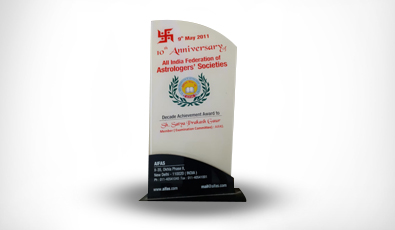 Member (Examination Committee) : AIFAS
  Cosmic Future Point
 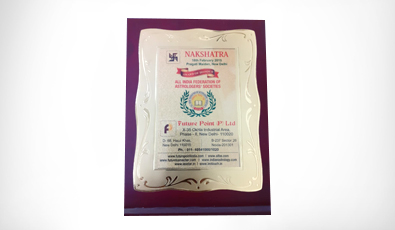 Nakshatra - Award of Honour : AIFAS
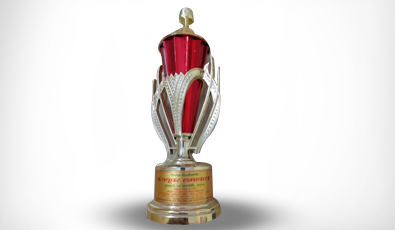
  AIFAS Award of Honour Trophy
 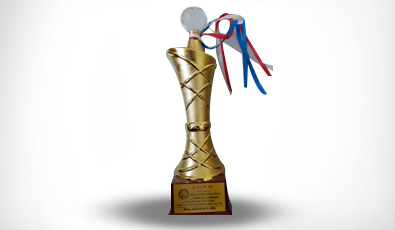 Akhil Bhartiya Jyotish Sammelan
 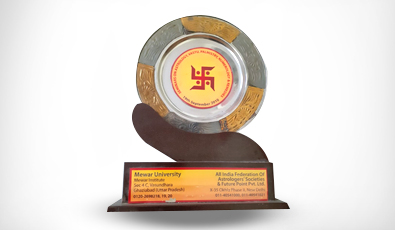 Award of Honour - Mewar University
 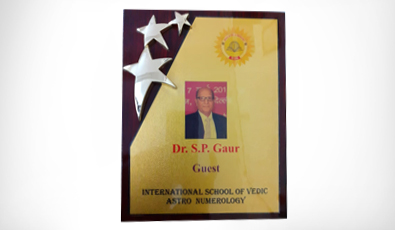 Guest of Honour - International School Of Vedic Astro Numerology
 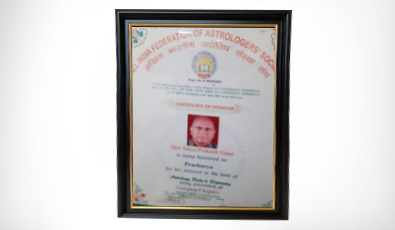 Certificate of Honour : AIFAS
 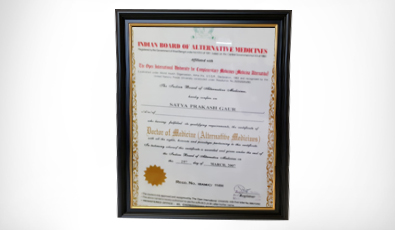 Doctor of Medicine - Indian Board of Alternative Medicines
 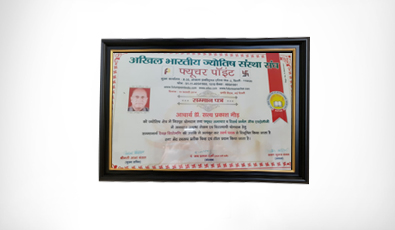 Samman Patra : AIFAS
 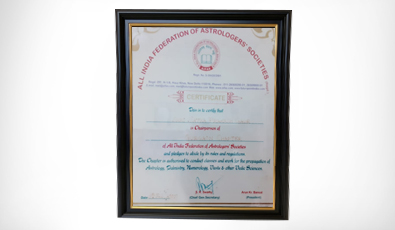 Certificate AIFAS
 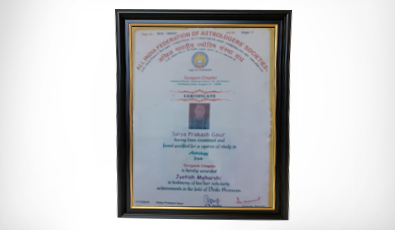 Jyotish Maharishi : AIFAS
 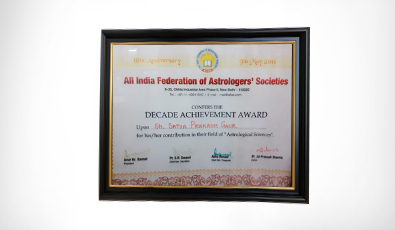 AIFAS - Decade Achievement Award